Boryeong, Chungcheongnam-do is home to numerous designated national heritage items, including National Treasures, Treasures, Historic Sites, Natural Monuments, National Folk Cultural Heritage, and Registered National Cultural Heritage. Key representations include the Stele of Monks Daenanghyesang at Seongjusa Temple Site, the Jukdo Submerged Artifact Deposit in Boryeong, the Evergreen Forest of Oeyeondo Island, the Monument for the Six Provincial Merchants' Association of Wonhongju, the Memorial Stone for Joint Memorial Services of Ancestors, the Monument Commemorating the Donation of Answered Agricultural Land by Bansujeong Geonmo, and Boryeong Cheongso Station.
Seongjusa Temple Site
Seongjusa Temple was initially established during the late Baekje period under the name Ohapsa, serving as a state-level temple dedicated to consoling fallen soldiers. After the fall of Baekje, it fell into ruins, but Master Muyum—who had studied Seon Buddhism in Tang China during the Unified Silla period—revived it on a grand scale. King Munsong of Unified Silla bestowed upon it the royal tablet name "Seongjusa."
Western Three-Story Stone Pagoda at Seongjusa Temple Site
Located to the west among the three stone pagodas behind the Geumdangji (main hall site) of Seongjusa Temple, this three-story pagoda rests on a two-tier platform. It is preserved with its topmost decorative finial (saryunbu) missing. Although previously presumed to be a stupa (budo), records in the Chronicles of Seongjusa Temple confirmed it as a Buddhist pagoda. Crafted from granite, it stands at a height of 443 cm.
Central and Eastern Three-Story Stone Pagodas at Seongjusa Temple Site
- Central Pagoda: Positioned in the middle among the three stone pagodas behind the Geumdangji, this three-story pagoda stands on a two-tier platform with a missing topmost finial. Characterized by sharply outlined eaves stones (okgaeseok), excavation surveys revealed that it was relocated from another spot within the temple site.
- Eastern Pagoda: Situated on the eastern side of the trio, this three-story pagoda rests on a two-tier platform and also lacks its topmost finial. Sharing the same architectural style as the Western Three-Story Stone Pagoda, it differs in height at 460 cm and is likewise made of granite.
Stele of Monks Daenanghyesang at Seongjusa Temple Site
Erected in the early 10th century by royal decree, this stele was authored by Choe Chiwon—the foremost scholar of his time—to honor Master Muyum (800–888), who greatly expanded the Seongjusa Seon school. The inscription details the life and deeds of Master Daenanghyesang Muyum in a long text spanning roughly 5,000 characters. As one of Choe Chiwon's surviving stele inscriptions, it serves as a valuable resource for studying Silla's bone-rank system and archaic Silla language.
Five-Story Stone Pagoda at Seongjusa Temple Site
Positioned between the Geumdangji and the stone lantern, this pagoda is presumed to be the Śākyamuni Buddha Relic Pagoda recorded in the Chronicles of Seongjusa Temple. Standing at a total height of 634 cm and crafted from granite, it features a five-story tower set upon a two-tier platform, reflecting the typical stone pagoda style of the late Unified Silla period.
Standing Stone Buddha at Seongjusa Temple Site
Located northeast of the lecture hall site (gangdangji), this standing stone image exhibits relatively graceful and refined craftsmanship despite its somewhat weathered facial features. With its right hand lowered and left hand raised against the abdominal area, the volume and linear treatment expressed in its garments and body reflect stylistic trends popular around the 9th century.
Stone Lantern at Seongjusa Temple Site
This Silla-style stone lantern was erected during the founding of Seongjusa Temple in the late Unified Silla period. Compared to its roof stone (okgaeseok), the fire chamber (hwasaseok) holding the light and the supporting pillar (ganseok) are slender, and the upper finial atop the octagonal roof stone is damaged. Standing 220 cm tall and made of granite, it has been restored from fragments.
Stone Stairs at Seongjusa Temple Site
Built during the Unified Silla period, these stone stairs lead up to the Geumdang (main hall) of Seongjusa Temple. Originally, stone lion sculptures stood on both sides, showcasing exceptionally exquisite carving techniques. However, the stone lions were stolen in 1986; the current site features the stone stairs alongside newly reconstructed stone lions based on historical photographs.
Boryeong Chungcheong Suyeongseong
Chungcheong Naval Headquarters Fortress
Layout and Current Status
During the Joseon Dynasty, seven naval headquarters (suyeong) were established as core centers for coastal defense. The Chungcheong Naval Forces Commander's Headquarters (Chungcheong Suyeong), serving as the command center for Chungcheong Province's coastal defense, was located in present-day Ocheon-myeon, Boryeong. The Chungcheong navy carried out crucial national defense missions, including escorting tax-grain transport ships, joining Admiral Yi Sun-sin in the southern seas to defeat Japanese forces during the Imjin War, and confronting Qing forces on Ganghwa Island during the Byeongja Horan (Manchu invasion). The total perimeter of the fortress is approximately 1.6 km. Portions have been restored, and remaining inner structures include the West Gate, the Janggyocheong (presumed guesthouse), and the Monument of Virtue for Regional Military Commander Yu.
Constructed to fit the natural terrain, the fortress forms an oval (egg-shaped) layout. It originally featured five gates: East, West, Minor West, South, and North. Due to road construction and urban development, most of the walls have been damaged, leaving only the West Gate standing. Also known as Manghwamun, the West Gate is arched, measuring 3 meters wide and 4 meters in height. The presumed North Gate site and a section of the wall are now gone where a road passes through. A square stone pillar—presumed to be building material from the gate—lies north of the East Gate site, while a portion of the yeojang (low defensive parapet walls with firing slits) remains on the southern wall's East Gate section.
Although partially damaged by private residences and roads, the southern wall is mostly well-preserved. While a Jinnammun Gate reportedly existed, its exact location can no longer be verified. Two chiseong (defensive bastions projecting outward from the wall to facilitate attacks on enemies) are identified along the southern wall, with additional bastions positioned at both of its corners.
Historical records and maps of Boryeong Chungcheong Suyeongseong document numerous structures that have since disappeared, including Unjuheon (where royal wooden tallies were sealed), Gonghaegwan (the naval commander's office space), and Yeongbojeong Pavilion.
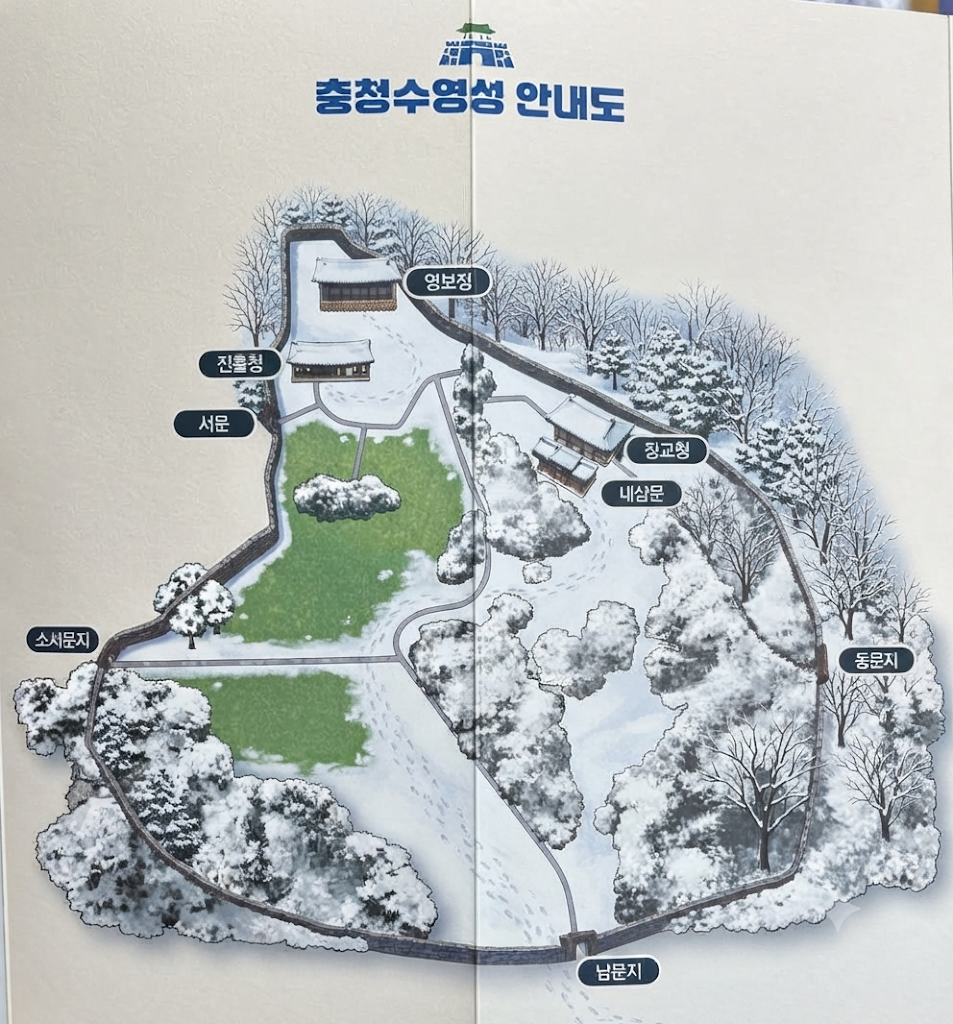
Guide to Chungcheong Suyeongseong Structures
Chungcheong Suyeong Janggyocheong (Officer's Hall)
Though traditionally designated as the Janggyocheong, it is also presumed to have served as a guesthouse (gaeksa). A guesthouse was where the naval commander enshrined the jeonpa (wooden tablet symbolizing the king), paid respects toward the royal palace on the 1st and 15th of every month, and accommodated officials dispatched from the central government. Following the abolition of the naval headquarters, it was used as a county office and school building before being relocated from its original site at Ocheon Elementary School to its present location.
Originally named Unjuheon as a guesthouse accommodation for central officials holding royal tallies, its name became confused with local history records after the naval headquarters was dissolved. Today, it stands on the northeast hill within Boryeong Chungcheong Suyeongseong, with the Chungcheong Suyeong Inner Triple Gate situated one tier lower to the south. Because both structures were relocated from their original sites, they functioned as separate buildings from the Janggyocheong.
Chungcheong Suyeong Jinhyulcheong (Relief Office)
The Jinhyulcheong was responsible for providing relief to impoverished residents within the Chungcheong Suyeong jurisdiction during times of famine. After the abolition of the naval headquarters, it was used as a private residence before the land and buildings were purchased for preservation in 1994. It features a hip-and-gable roof (paljak jibung) spanning five bays wide by two bays deep, complete with a wide wooden veranda (daecheong), heated ondol rooms, an open veranda (toetmaru), and a kitchen. Because its exact original designation lacks written records, it is presumed to be the Jinhyulcheong based on building layouts depicted in old maps of Chungcheong Suyeong.
Chungcheong Suyeong Inner Triple Gate
This gate originally served as the entrance to the Gonghaegwan (the commander's office). While the Gonghaegwan itself is gone, only the triple gate remains. Preserved alongside the guesthouse building behind it, it was relocated from the Ocheon Elementary School site. It served as the gate to the naval commander's office until the headquarters was closed in 1896, subsequently functioning as the county office gate when Ocheon County was established, and later as the gate for the Ocheon-myeon Office until 1986. Following the construction of a new Ocheon-myeon Office in 1987, it was moved to its current location.
Traditional Temples, Hyanggyo, and Seowon in Boryeong
Geumgamam and Baekwonsa Temples
- Geumgamam: Built as a royal ancestral prayer temple under the joint initiative of Kwon Hong and his daughter Princess Yi (concubine of King Taejong of Joseon), it preserves a seated stone Buddha statue and stele fragments from that era, reflecting its deep historical roots. It was registered as a traditional temple in 1992 and operates as a sub-temple of Magoksa Temple (the 6th District of the Jogye Order of Korean Buddhism).
- Baekwonsa: Reputedly founded by National Master Beomil during the Unified Silla period, it has been preserved through repeated renovations up to the Joseon Dynasty. Temple holdings include the Provincial Intangible Cultural Heritage "Wooden Seated Bodhisattva" and the Cultural Heritage Material "Baekwonsa Version of the Painting of Shanshin by Yeong-sik." Located 100 meters below the temple is the Provincial Intangible Cultural Heritage "Baekwonsa Stupa," estimated to have been crafted during the Joseon Dynasty.
Hwaamseowon and Boryeong Hyanggyo
- Hwaamseowon: Established in 1610 (the 2nd year of King Gwanghaegun's reign) under the leadership of Chungcheong Provincial Governor Jeong Yeop and Gu Gye-u (a disciple of Yi Ji-ham). Designated as Hwaam Seowon in 1686 (the 12th year of King Sukjong), it was closed in 1868 (the 5th year of King Gojong) under Regent Heungseon Daewongun's nationwide order to abolish seowon, but was re-established in 1922. It was moved to its current location in 1959 due to the construction of the Cheongcheon Reservoir.
- Boryeong Hyanggyo: Presumed to have been founded during the reign of King Taejong—when local Confucian schools (hyanggyo) were established across administrative districts during the early Joseon Dynasty—it has undergone three rounds of renovation. Existing structures include the Daeseongjeon (main shrine hall featuring a plain gable roof measuring 5 bays wide by 3 bays deep) alongside five subsidiary buildings. The East and West Dormitories (Dongjae and Seojae) served as student quarters, while the Myeongnyundang served as the lecture hall. The Daeseongjeon enshrines the spirit tablets of Confucius, China's Five Sages, Four Worthies, and Korea's Eighteen Scholars (Dongbang Sipals-hyeon).